

For fourteen years, Malaak Compton-Rock was known primarily as Chris Rock’s wife. That framing was always reductive and became, after their 2016 divorce, entirely obsolete. She had built a career in philanthropy and social entrepreneurship before the marriage, sustained it throughout, and continued it after — on her own terms and under her own name.
Compton-Rock is a legitimate figure in international humanitarian work, the founder of a nonprofit that took underprivileged American children to South Africa for service immersion, and a communications professional with a corporate career that predates any celebrity association. The marriage made her famous. The work is what she actually is.
Info Table
| Field | Details |
|---|---|
| Full Name | Malaak Compton-Rock |
| Born | November 28, 1969 |
| Birthplace | Washington, D.C. |
| Nationality | American |
| Heritage | African-American |
| Father | Charles Compton |
| Mother | Malaak Compton (Sr.) |
| Education | Howard University — B.A. Communications |
| Occupation | Philanthropist; Social Entrepreneur; Author; Public Speaker; Communications Professional |
| Known For | Founder of StyleWorks and Journey to Freedom; former wife of Chris Rock |
| Ex-Husband | Chris Rock (m. November 23, 1996 — div. 2016) |
| Children | Lola Simone Rock (b. 2002); Zahra Savannah Rock (b. 2004) |
| StyleWorks | Nonprofit — free salon services for women transitioning out of welfare into workforce |
| Journey to Freedom | Nonprofit — took underprivileged American youth to South Africa for service immersion |
| Corporate Career | PR and communications roles at Saks Fifth Avenue, Revlon, and others |
| Book | If It Takes a Village, Build One (2010) |
| Awards | Multiple humanitarian and community service recognitions |
| Advocacy Focus | Poverty alleviation; youth empowerment; women’s workforce entry; global service |
| Net Worth | ~$10 million estimated |
Early Life and Education
Malaak Compton was born November 28, 1969, in Washington, D.C. — a city whose particular culture of civic engagement and political awareness would prove formative. She grew up with an orientation toward service that preceded any professional framework for it, shaped by a family environment that took community responsibility seriously.
She attended Howard University, the historically Black institution in Washington that has produced a disproportionate share of African-American leaders in law, politics, medicine, and the arts. She graduated with a degree in communications — a practical foundation that would serve both her corporate career and her eventual nonprofit work. Howard’s particular culture of excellence and social responsibility was not incidental to who she became.
Corporate Career: Before the Spotlight
Before Chris Rock, before the nonprofits, before the public profile, Malaak Compton built a conventional and successful career in public relations and communications. She worked in PR roles at major corporate entities including Saks Fifth Avenue and Revlon — serious, competitive environments that required professional competence entirely unrelated to celebrity adjacency.
This period of her career is frequently glossed over in coverage that jumps directly to her philanthropic work or her marriage, but it matters. It established that she was a working professional with marketable skills and industry standing before any external circumstance elevated her profile. The nonprofit work that followed was a choice made from a position of professional security, not a reinvention born of necessity.
StyleWorks: The First Nonprofit
In the mid-1990s, Compton-Rock founded StyleWorks, a nonprofit organization based in New York City that provided free salon services — haircuts, styling, grooming — to women transitioning off welfare and into the workforce.
The premise was grounded in a practical insight: that appearance and presentation are genuine barriers to employment for women exiting welfare, and that the cost of professional grooming is not trivial for someone with no income. StyleWorks addressed that specific, concrete obstacle rather than the broader, harder-to-solve problems of poverty — a focused intervention that produced measurable outcomes.
The organization worked with professional stylists who volunteered their time and skills, connecting them with women who needed the service. It was the kind of program that sounds simple and is operationally complex — building reliable volunteer networks, maintaining consistent service quality, and reaching the women who needed it most required sustained organizational work.
StyleWorks established Compton-Rock’s model: identify a specific, underserved need; build a practical structure to address it; execute with professional rigor. She would apply the same model at larger scale with her next initiative.
Journey to Freedom
Journey to Freedom was Compton-Rock’s most ambitious and internationally visible project — a nonprofit program that brought underprivileged youth from the United States to South Africa to participate in community service work alongside local organizations.
The program’s design was intentional on multiple levels. It exposed American children who had never left their neighborhoods — let alone their country — to a world that reframed their own circumstances. It connected them with South African communities navigating the post-apartheid landscape. And it structured the experience around service rather than tourism, requiring participants to contribute rather than simply observe.
Compton-Rock ran the program for years, personally accompanying groups of young people to South Africa and documenting the experience through her public platform. The photographs and accounts she shared — children from Harlem and Newark working alongside South African peers, processing what they saw and what it asked of them — generated significant attention and brought international visibility to the program.
Journey to Freedom represents the most complete expression of her philanthropic philosophy: that service is transformative for the person performing it as much as for those receiving it, and that exposing young people to global context changes their understanding of their own possibilities.
Marriage to Chris Rock
Malaak Compton and Chris Rock married on November 23, 1996. He was already a significant cultural figure — his 1996 HBO special Bring the Pain had elevated him to the first rank of American comedians. She was a working professional and nonprofit founder. They were, at the outset, two people with independent careers making a life together.
They have two daughters: Lola Simone, born in 2002, and Zahra Savannah, born in 2004. Both children have been kept largely out of the public eye — a boundary Compton-Rock has maintained consistently and firmly.
The marriage became publicly complicated in ways that neither party has fully detailed. Chris Rock has acknowledged infidelity in interviews and in his 2023 Netflix special Selective Outrage — discussing an affair with a fellow celebrity that he described as damaging to the marriage and to his own integrity. The divorce was filed in 2014 and finalized in 2016 after nearly two decades of marriage.
The divorce proceedings included a disputed custody element that became briefly public: questions arose regarding a child whose status was contested. Compton-Rock addressed the situation directly, firmly, and without elaboration — consistent with her general approach to private matters that become public through no choice of her own.
Book: If It Takes a Village, Build One
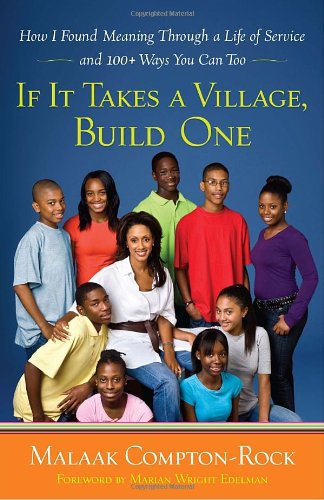
In 2010, Compton-Rock published If It Takes a Village, Build One: How I Found Meaning Through a Life of Service and How You Can Too, released through Crown Publishers. The book is part memoir, part practical guide — drawing on her experience with StyleWorks, Journey to Freedom, and her broader philosophy of service-based living.
It is not a celebrity memoir. It does not dwell on her marriage or her proximity to fame. It is a book about how to build something meaningful, written by someone who had done it twice. The reception was respectful, and it solidified her standing as a voice in the philanthropy and civic engagement space rather than simply a public figure with a cause.
Post-Divorce: Continuity and Resilience

What is notable about Compton-Rock’s post-divorce trajectory is how little it changed. She continued her advocacy work, her public speaking, and her nonprofit involvement. She maintained her public profile without trading on the divorce narrative that celebrity culture typically monetizes aggressively.
She has spoken in interviews about the personal difficulty of the divorce and of co-parenting in a high-visibility environment — with the honesty of someone who takes her daughters’ wellbeing more seriously than her own image management. Her public statements about Chris Rock have been measured and non-retaliatory, even as his public comedy has occasionally touched on the marriage and its dissolution.
The 2022 Oscars incident — in which Will Smith slapped Chris Rock on live television over a joke about Jada Pinkett Smith’s appearance — brought Compton-Rock’s name briefly back into public conversation, as observers noted the irony of a comedian whose public material had addressed his ex-wife’s experience becoming a victim of public humiliation himself. She did not comment.
Legacy and Continuing Work
Malaak Compton-Rock’s legacy sits at the intersection of two things that don’t always coexist: genuine humanitarian impact and professional communications sophistication. She understood, from her corporate career forward, how to build and maintain a public presence that served a mission rather than a personal brand.
StyleWorks changed specific women’s access to employment. Journey to Freedom changed specific children’s understanding of the world. If It Takes a Village put her framework into a form that others could learn from and apply. These are concrete outcomes in a philanthropic landscape full of gestures.
She is also, simply, an example of a woman who was defined by her marriage for fourteen years, declined to be defined by her divorce, and continued doing the work she had always done. In a cultural environment that rewards victimhood narratives and public dissolution, that continuity is its own kind of statement.
Conclusion
Malaak Compton-Rock built her career before fame found her, sustained it through the years fame surrounded her, and kept building after it receded. The work — StyleWorks, Journey to Freedom, the book, the advocacy — was never about the spotlight. That’s precisely what makes it credible.
FAQs
Who is Malaak Compton-Rock? A Washington D.C.-born philanthropist, social entrepreneur, and author — founder of StyleWorks and Journey to Freedom, and former wife of comedian Chris Rock.
What is StyleWorks? A nonprofit Compton-Rock founded that provides free salon and grooming services to women transitioning from welfare into the workforce, removing a practical barrier to employment.
What is Journey to Freedom? A nonprofit program she created that brought underprivileged American youth to South Africa to participate in community service alongside local organizations.
When did she marry and divorce Chris Rock? They married November 23, 1996 and divorced in 2016 after nearly two decades of marriage.
Does she have children? Yes — two daughters with Chris Rock: Lola Simone (b. 2002) and Zahra Savannah (b. 2004).
Did she write a book? Yes — If It Takes a Village, Build One (2010), a combined memoir and practical guide to building a life around service and civic engagement.
