

Leyman Lahcine is a French-Algerian visual artist born in 1987 in Grenoble, France, who lives and works in London. He is a resident artist at the Sarabande Foundation — the legacy arts organisation established by the late fashion designer Lee Alexander McQueen — and is known for a painting style best described as faux naïf: bright colours, cartoon-like figures, and childlike line work that, on closer inspection, carries real emotional weight. His work weaves together religious symbolism, mythological references, and the concept of transgenerational trauma into imagery that feels simultaneously playful and deeply unsettled.
He is also, more widely, known as the former long-term partner of British singer and cultural icon Paloma Faith. But to introduce him only through that lens would be to miss the point of who he actually is.
Quick Facts: Leyman Lahcine
| Detail | Information |
|---|---|
| Full Name | Leyman Lahcine |
| Born | 1987 |
| Birthplace | Grenoble, France |
| Nationality | French-Algerian |
| Based In | London, England |
| Profession | Visual Artist, Designer |
| Artistic Style | Faux naïf; bright colour, cartoon imagery, dark emotional undertones |
| Medium | Painting, Drawing, Sculpture |
| Foundation | Sarabande Foundation, London (resident artist) |
| Commercial Platform | House of Bandits (Sarabande’s sales platform) |
| Notable Collaboration | Roland Mouret x Etat Libre d’Orange — Une Amourette (2019) |
| Key Exhibition | Tides of Consciousness solo show, Sarabande Foundation (Feb–Mar 2024) |
| Former Partner | Paloma Faith (together approx. 2013–2022) |
| Children | Two daughters |
| Key Artistic Influence | The City of Lost Children (Jeunet & Caro, 1995); Jean Cocteau; Daniel Johnston |
Early Life — Grenoble, Algeria, and Growing Up Between Worlds
Grenoble sits in a valley in southeastern France, surrounded by the Alps. It is an industrial city with a strong North African immigrant community — and it is where Leyman Lahcine was born and raised in 1987, the child of Algerian parents.
Growing up with dual French-Algerian identity is not a simple experience. It means navigating two sets of cultural expectations, two histories that don’t always sit comfortably beside each other, and a constant low-level question of where, exactly, you belong. That tension doesn’t disappear when you grow up. It gets absorbed into the body, the worldview, and — in Lahcine’s case — the work.
He has spoken about finding his way to art through darkness rather than light. The film that changed everything for him was La Cité des Enfants Perdus — The City of Lost Children — the 1995 surrealist dark fantasy by Jean-Pierre Jeunet and Marc Caro. He watched it obsessively as a child, almost every day for several years.
“I am most influenced by film,” he told AnOther Magazine. “One of my favourite films is The City of Lost Children. That film was a starting point for me. I was so young when it came out, and I watched it every day for a few years as a kid. It’s a dark film. I think you have to be in a good place to step into that darkness. I think that film made me realise I didn’t have to be the same as other people; that it was okay to be different.”
The film — about a mad scientist who kidnaps children to steal their dreams — has an eerie resonance with what Lahcine would eventually build as an artist: a world full of figures carrying things they didn’t choose to carry, in spaces where childhood and dread inhabit the same room.
Drawing became his first language.
“I started drawing as a way to write my nightmares or frustrations — it’s always been a kind of diary for me.”
Education — From France to New York to London
Lahcine eventually studied at the University for the Creative Arts (UCA) in England, before completing a Master’s degree in Fashion at Kingston University London, graduating in 2016. The fashion training gave him a formal structural framework for thinking about the body, about material, about how images relate to the physical world — something that still shows in the way he makes his frames and incorporates found materials into his pieces.
Before London became home, there was a chapter in New York. He worked there as a designer, eventually founding his own fashion label — Gentlemen’s Recess — and absorbing the specific energy of the New York art and fashion scene. But he didn’t stay. London, eventually, won out. Partly because of where his practice was heading. Partly because of who he met there.
Artistic Style — What “Faux Naïf” Actually Means
The label faux naïf gets attached to Lahcine frequently, and it’s worth unpacking what it actually describes — because it isn’t a dismissal. It’s a precise aesthetic category.
Naïf art typically refers to work that appears childlike or untrained — simple forms, flat perspective, bright unmodulated colours. Faux naïf means deliberately choosing that aesthetic while being fully trained, using apparent simplicity as a conscious artistic strategy rather than a limitation.
In Lahcine’s case, the cartoon figures and playful line work aren’t evidence of technical limitation. They are the method. The simplicity of the visual surface creates a kind of dissonance — because what’s happening inside those simple forms is heavy. Grief. Inheritance. The invisible weight of what one generation passes to the next without meaning to.
His paintings don’t announce their darkness. They wear it lightly, which somehow makes it more persistent.
The Sarabande Foundation describes his visual vocabulary plainly: bright colour, cartoon-like imagery operating in a dark and melancholic mood. That friction — the joyful surface against the sombre interior — is the engine of the work.
He also has a genuinely voyeuristic practice. Characters in his paintings frequently originate from overheard conversations — fragments of other people’s lives that he catches in passing and carries back to the studio.
“It’s a little like walking past someone’s window and peeking inside, then feeling guilty because you have caught their eye,” he told AnOther.
The paintings often incorporate rustic, artist-made frames — hand-built, sometimes using cobbled found materials — which adds a sculptural quality to the pieces. They become objects as much as images. The frame isn’t neutral; it’s part of the work.
Key Themes in His Work
| Theme | How It Appears |
|---|---|
| Transgenerational trauma | Figures bearing burdens passed down from previous generations |
| Religious iconography | Sacred symbols, ritual imagery woven into secular scenes |
| Mythology | Classical and North African mythological references |
| The unconscious mind | Dream logic, symbols, surreal juxtaposition |
| Childhood & innocence | Cartoon aesthetics, nostalgic visual language |
| Cultural identity | French-Algerian heritage expressed through visual choices |
| Love and human connection | Tender, emotionally charged imagery of connection |
| The overheard moment | Characters born from fragments of strangers’ conversations |
The Sarabande Foundation — A Studio Above the Stadium
The Sarabande Foundation was established in 2006 by Lee Alexander McQueen — the late, visionary fashion designer — with the explicit ambition of supporting the most creatively fearless artists of the future. After McQueen’s death in 2010, the foundation carried that mission forward, providing studio space, mentorship, exhibition platforms, and commercial infrastructure for emerging artists.
Lahcine became a resident artist at Sarabande’s North London townhouse — located across a walkway from Tottenham Hotspur’s stadium in Haggerston — and it is from that small third-floor studio that much of his recent work has emerged.
A journalist visiting him in spring 2024 for Something Curated described the scene: sketchbooks open on the desk, ambient sound from an old NTS radio show, the smell of palo santo and dried oil paint in the air. Lahcine showed them a tuning fork, tapped it, and waited for it to ring out.
“I think I like this idea of harmony,” he said. “It’s peace.”
That image — the tuning fork as a symbol of something sought rather than achieved — says a great deal about the sensibility that runs through his work.
Tides of Consciousness — His Solo Exhibition (2024)
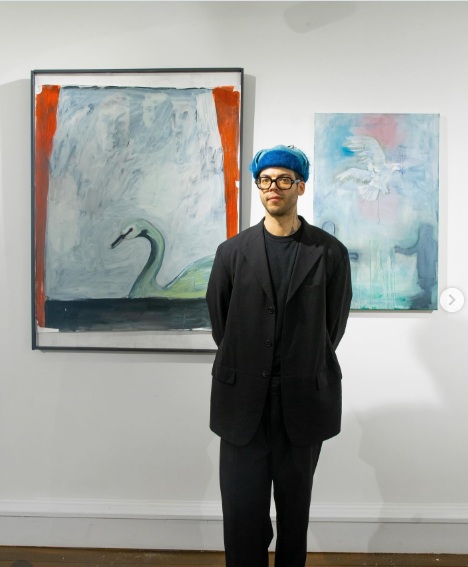
In February and March 2024, Lahcine held his solo exhibition Tides of Consciousness at the Sarabande Foundation. It ran from 29 February to 3 March.
The show used paintings, drawings, and sculpture to explore the relationship between conscious and unconscious thought — how symbols emerge from the depths of the mind, how we make meaning from images we didn’t choose to dream.
The Sarabande Foundation described the exhibition as an exploration of symbols as expressions of the unconscious, with works attempting to capture the dialogue between the two states of mind. Religious and mythological references appeared throughout, alongside the recurring concept of collective subconscious and the emotional burdens passed between generations.
It was not a simple show. But it didn’t try to be.
Available Works — Through House of Bandits
House of Bandits is Sarabande Foundation’s commercial sales platform, where artists’ works are made available directly to collectors and the public. Lahcine’s pieces have been listed there at various price points.
| Work | Medium | Price (incl. VAT) |
|---|---|---|
| Shadows in the Corridor | Acrylic and Oil on Panel, Wood Frame with Steel Fastening | £812.50 |
| The Martyr in Water | Mixed media | £1,000.00 |
| Love Dance | Mixed media | £1,333.33 |
Love Dance is described in the listing with notable warmth: emotionally charged, exuberant, and joyous — a celebration of love and companionship in bright paint. It sits in interesting contrast with some of the heavier work in his catalogue. But that contrast is very much the point.
He was also included in Sarabande’s 2024 Summer Group Show — A Place: Part 2: …Stay Longer — which ran through August and into early September 2024, featuring ten resident artists responding to the concept of place.
The Roland Mouret Collaboration — 50 Bottles, Hand-Drawn
In 2019, fashion designer Roland Mouret commissioned Lahcine to create a limited-edition artwork for his fragrance Une Amourette — a scent produced in collaboration with the French perfume house Etat Libre d’Orange, first launched in 2017.
Rather than designing something to be printed onto the bottles, Lahcine drew directly onto each one by hand. Every single bottle was individually illustrated — which meant each of the 50 was genuinely unique. No two were identical.
Mouret asked Lahcine what an amourette — French for a brief fling, a moment of passion — meant to him. The answer came back as imagery: the moon gazing at the sun in its embrace; hands and petals; romantic, almost childlike drawings that Roland Mouret described as capturing a bold, playful, and somewhat irreverent spirit. A celebration of love, visualised.
The 50 bottles were sold exclusively in the UK, through Mouret’s flagship store at 8 Carlos Place in Mayfair and online.
Lahcine was direct about his approach to the collaboration. “I always try to follow and trust my creativity, so I stay loyal to my identity as an artist,” he said. “Shaping a style that is personal to me is the most important aspect of being creative.”
That principle — staying loyal to his identity regardless of context — runs through everything he has done publicly.
Leyman Lahcine and Paloma Faith — A Decade Together
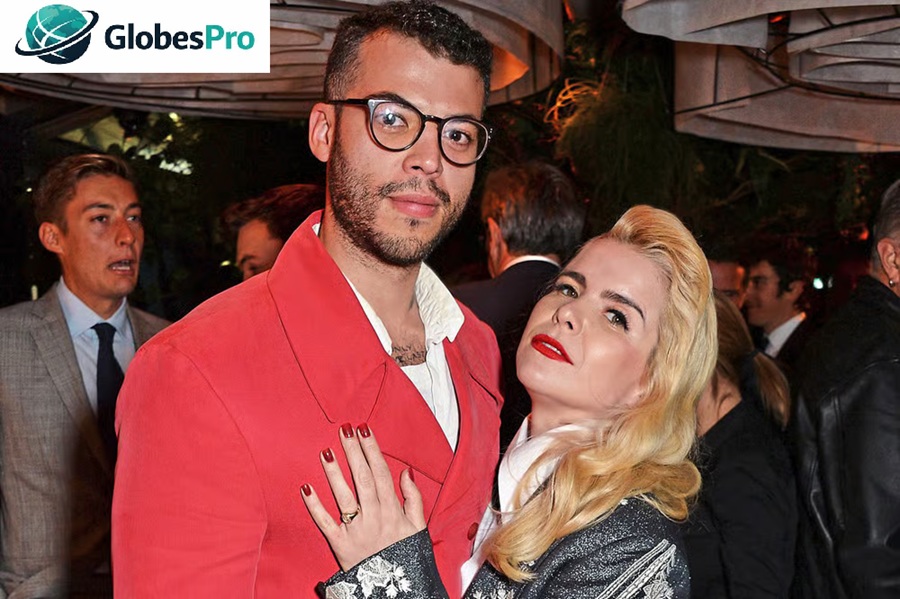
Lahcine and Paloma Faith met around 2013 and were together for roughly nine years. Faith is one of Britain’s most distinctive singer-songwriters — known equally for her voice, her eccentric vintage style, and her genuine willingness to speak about hard personal experiences in public.
She spoke often about Lahcine with real warmth. “Leyman is my husband,” she said in a widely quoted interview. “You don’t need a marriage certificate.” That was a statement of conviction, not a legal loophole. She meant it literally: he was her partner in every meaningful sense.
Their first daughter was born in December 2016, after a pregnancy that had followed some early difficulties. Their second daughter was born in February 2021, conceived through their sixth round of IVF — a journey that Faith documented publicly, with characteristic honesty, including the miscarriage she experienced in 2019 and the emotional toll of repeated fertility treatment.
Throughout all of that, Lahcine remained mostly out of the picture publicly — in the best sense. He was present in her life; he was just not interested in being present in the coverage of it.
In 2022, Paloma Faith confirmed that the couple had separated. She described the split as the worst thing that had happened to her. Both have continued to co-parent their daughters, and by all public accounts the co-parenting relationship has been handled with maturity and mutual respect.
His Artistic Philosophy — In His Own Words
A few quotes, gathered from interviews over the years, give a real sense of the interior life behind the work:
| Quote | Context |
|---|---|
| “I started drawing as a way to write my nightmares or frustrations — it’s always been a kind of diary for me.” | On the origins of his practice |
| “I just like drawing the way children draw.” | When asked if he considers himself a political artist |
| “I always try to follow and trust my creativity, so I stay loyal to my identity as an artist.” | On the Roland Mouret collaboration |
| “It’s a little like walking past someone’s window and peeking inside, then feeling guilty because you have caught their eye.” | On the voyeuristic nature of his painting |
| “I think I like this idea of harmony. It’s peace.” | Holding a tuning fork in his studio, spring 2024 |
That last image is perhaps the most revealing. A man sitting in a studio above a football stadium, thumbing through old sketchbooks, tapping a tuning fork, and waiting for the resonance to settle. That is the sensibility. Not dramatic. Not performative. Just genuinely curious about what equilibrium feels like.
Artistic Influences — The Figures Behind the Work
Lahcine’s reference points are specific and reveal a lot about where his aesthetic sits.
| Influence | Why It Matters |
|---|---|
| Jean Cocteau | French polymath; combined mythology with childlike drawing; emotional surrealism |
| Daniel Johnston | American outsider artist and musician; raw, personal, emotionally direct imagery |
| Chapman Brothers | British artists known for disturbing imagery inside cartoonish aesthetics |
| The City of Lost Children (Jeunet & Caro) | Surrealist dark fantasy; childhood and nightmare occupying the same space |
| NTS Radio, ambient music | The sonic environment of his studio practice |
| Overheard conversations | The raw material of his character work |
The Chapman Brothers comparison is particularly interesting. Their work — Grand Macabre sculptures, defaced Goya prints — uses the visual language of children’s toys and cartoons to house genuinely disturbing content about war, death, and human cruelty. Lahcine operates in related territory, though his darkness is more personal and less provocative. It’s grief and inheritance, not spectacle.
Why Leyman Lahcine Matters Now
There is a broader conversation happening in contemporary art around outsider aesthetics, diaspora identity, and the representation of inherited trauma. Lahcine sits right in the middle of it — not because he chose that positioning strategically, but because it is simply what he is.
A French-Algerian man making images about the weights we carry, in London, at a foundation built by a working-class kid from East London who became one of the most important fashion designers of his generation. There is something fitting about that institutional home.
His work asks questions that don’t have tidy answers. What do we inherit from people who never meant to pass anything difficult to us? How do symbols move between generations, between cultures, between the sleeping mind and the waking one? What does it look like when joy and grief occupy the same image?
Those are not niche questions. They are, in many ways, the questions of the moment.
Conclusion
Leyman Lahcine is not a celebrity-adjacent figure who also happens to paint. He is a genuinely serious artist who also happened to be, for a decade, the partner of a very famous woman. The distinction matters — because collapsing those two things means missing what he is actually doing in that third-floor studio above the Tottenham stadium.
He draws the way children draw. He paints the things that keep you up at night. He combines religious symbols with cartoon figures and calls the result a meditation on transgenerational trauma. He hand-drew 50 perfume bottles for Roland Mouret and charged every one with the imagery of the moon in love with the sun.
And then he goes back to the studio, picks up the tuning fork, and listens for harmony.
That is the work. It is worth paying attention to.
