

If you’ve stumbled upon bizarre fish memes featuring a creature with an unnervingly wide, flat face and tiny, vacant eyes, you’ve already met sacabambaspis without even knowing its name. This prehistoric armored fish, which lived approximately 470 million years ago during the Ordovician period, has experienced an unexpected renaissance in internet culture. But beyond the memes lies a fascinating creature that represents a crucial chapter in vertebrate evolution—one of the earliest known fish with a proper backbone and a revolutionary design that would influence countless species to come.
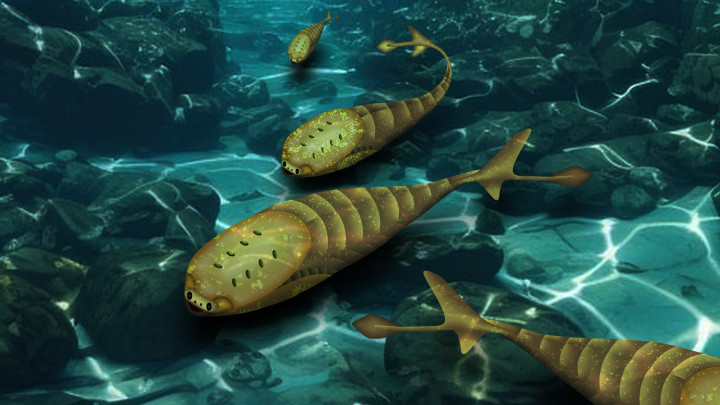
Sacabambaspis was a jawless fish that measured roughly 10 inches in length, sporting heavy bony armor across its head and front body. Despite its comical appearance in modern reconstructions, this ancient creature was perfectly adapted to its environment, filter-feeding along the ocean floor in what is now South America, particularly in regions of Bolivia where its fossils were first discovered. Its peculiar facial structure, complete forward-facing eyes, and downturned mouth weren’t design flaws but evolutionary innovations that allowed it to thrive in shallow coastal waters for millions of years.
Quick Facts About This Ancient Fish
| Characteristic | Details |
|---|---|
| Time Period | Ordovician (approximately 470 million years ago) |
| Size | Around 10 inches in length |
| Diet | Filter feeder (organic particles and small organisms) |
| Habitat | Shallow coastal marine environments |
| Geographic Location | Primarily South America (Bolivia) |
| Classification | Jawless fish (Arandaspid) |
| Key Features | Heavy bony head armor, forward-facing eyes, bottom-dwelling |
| Extinction Status | Extinct (died out by end of Paleozoic era) |
A Window Into Prehistoric Oceans
The world during the Ordovician period looked nothing like our modern Earth. Continents were positioned differently, plants hadn’t yet colonized land, and the oceans teemed with strange invertebrates and early vertebrates experimenting with different body plans. Sacabambaspis emerged during this transformative era as part of a group called arandaspids, primitive jawless fish that represent some of the earliest vertebrates with mineralized skeletons.
These ancient fish didn’t have the luxury of jaws, teeth, or paired fins that later fish would develop. Instead, they possessed a simple suction-feeding mouth that worked like a biological vacuum cleaner. As they glided along the seafloor, they would suck up organic particles, small organisms, and detritus from sediment. The heavy armored plates covering their head and gill region served as protection against the various predators of the time, including massive sea scorpions and early cephalopods.
The fossil record shows that these creatures inhabited shallow marine environments, likely staying close to coastlines where food was abundant. Their body design—heavily armored in front but flexible in the rear—allowed them to remain stable while feeding in areas with strong currents while still maintaining enough mobility to escape danger when necessary.
The Anatomy of an Internet Legend
What makes this prehistoric fish so memorable, and occasionally unsettling, is its distinctive facial anatomy. The creature possessed eyes positioned on the front of its head rather than the sides, giving it a face that appears almost comically forward-facing by fish standards. These eyes were small and lacked the sophisticated structure found in modern fish, but they were functional enough to detect movement and light variations in the murky coastal waters it inhabited.
The mouth sat low on the underside of the head, perfectly positioned for bottom-feeding. This arrangement meant that when viewed head-on, the fish displayed what internet users have lovingly (or mockingly) described as a “depressed” or “existentially exhausted” expression. The broad, flattened head shield extended well beyond the body’s width, creating a shape reminiscent of a shovel or, as some have suggested, a face that has given up on life entirely.
Behind the armored head region, the body tapered into a more flexible, scaleless tail section. This tail featured a simple fin structure that provided propulsion through undulating movements. The contrast between the rigid, heavily protected front and the soft, mobile rear created an almost two-part body design that was common among early armored fish.

Why Sacabambaspis Matters to Science
Beyond its meme-worthy appearance, this ancient creature holds tremendous scientific significance. It represents a crucial evolutionary stepping stone between the earliest vertebrate ancestors and the diverse array of fish that would eventually dominate Earth’s waterways. By studying its fossils, paleontologists have gained insights into how vertebrate bodies became organized, how protective armor evolved, and how early sensory systems developed.
The bony armor plates found in these fossils reveal information about the creature’s growth patterns. Like tree rings, the layers within these plates show periods of rapid and slow growth, helping scientists understand the life cycle and environmental conditions these fish experienced. Some specimens show evidence of injury and healing, suggesting they faced regular threats from predators but possessed robust enough physiology to survive and recover.
Fossil discoveries have been concentrated primarily in South America, particularly in the Sacabamba region of Bolivia where the genus gets its name. However, related species have been found in other parts of the world, indicating these early armored fish achieved relatively wide geographic distribution during their time on Earth. Each new fossil discovery helps refine our understanding of early vertebrate diversity and the environments they inhabited.
The Great Meme Migration
The transformation of an obscure Ordovician fish into an internet sensation represents one of the stranger turns in paleontology’s public profile. The memes typically feature crude or intentionally unsettling reconstructions of the fish, often with exaggerated features that emphasize its unusual face. Captions frequently anthropomorphize the creature as embodying depression, anxiety, or existential dread—emotions that, needless to say, a Paleozoic fish almost certainly didn’t experience.
This memetic popularity has had an interesting side effect: it’s introduced millions of people to a creature they would never have encountered otherwise. Paleontology museums have reported increased interest in early fish evolution, and educators have leveraged the meme’s popularity to teach about vertebrate origins. What started as internet humor has become an unexpected gateway into serious science.
The reconstructions used in these memes are based on legitimate fossil evidence, though artists often take creative liberties with soft tissue features like eye size and mouth position. Scientists create these reconstructions by examining the preserved hard parts—primarily the bony head shield and scale impressions—then making informed guesses about the soft tissues based on comparisons with related species and modern analogues.
Life in the Ordovician Oceans
To truly understand this creature, we need to visualize its world. The Ordovician period, spanning from about 485 to 443 million years ago, was a time of explosive diversification in marine life. The seas were warm, oxygen levels were high, and vast shallow continental shelves provided ideal habitat for countless species.
These ancient fish shared their environment with trilobites, which carpeted the seafloor in enormous numbers. Massive orthocone cephalopods, some reaching lengths of over 20 feet, prowled the waters as apex predators. Colonies of graptolites drifted through the water column, while early corals and bryozoans built reef-like structures in shallow areas.
The fish itself would have spent most of its time cruising slowly over the seafloor, its mouth continuously filtering sediment for edible particles. Its armored head provided protection from above, suggesting that threats came primarily from larger swimming predators rather than from below. The small eyes indicate that vision wasn’t its primary sense—it likely relied more heavily on detecting vibrations and chemical signals in the water to find food and avoid danger.
Reproduction remains a mystery, as soft tissue rarely fossilizes. However, scientists believe these early fish likely reproduced through external fertilization, releasing eggs and sperm into the water column in a manner similar to many modern jawless fish like lampreys and hagfish.
Evolutionary Context and Legacy
The importance of studying creatures like this extends far beyond the animal itself. These early armored fish represent experiments in vertebrate body design that occurred hundreds of millions of years before the first dinosaurs appeared. Some of these experiments succeeded and gave rise to new lineages; others, like the arandaspids, eventually went extinct, leaving only fossils as evidence of their existence.
The heavy armor approach proved successful for many millions of years but eventually gave way to more streamlined, agile body designs. The development of jaws, which occurred in later fish lineages, represented a massive evolutionary advantage that armored jawless fish couldn’t match. By the end of the Devonian period, often called the “Age of Fishes,” the seas were dominated by jawed fish with more sophisticated designs, and the armored jawless fish had largely disappeared.
Yet their genetic legacy persists. Modern jawless fish like lampreys and hagfish are distant relatives of these ancient creatures, though they’ve lost the heavy armor in favor of different survival strategies. Every vertebrate alive today, including humans, can trace its ancestry back through the lineage that included these early armored fish.
Distinguishing Fact from Fiction
The internet’s embrace of this prehistoric creature has unfortunately led to some misconceptions. Many memes feature highly exaggerated or anatomically inaccurate reconstructions designed for comedic effect rather than scientific accuracy. While the basic shape—broad flat head with forward-facing eyes—is correct, many details are speculative or deliberately distorted.
For instance, the exact size and positioning of the eyes remain subjects of scientific debate. The soft tissue around the mouth and the precise feeding mechanism involve educated guesses based on related species. The body’s coloration, which appears in some reconstructions, is pure speculation since color rarely if ever preserves in fossils of this age.
Scientists continue to refine their understanding as new fossils are discovered and new analytical techniques become available. Modern imaging technology allows researchers to examine fossils in unprecedented detail, revealing structures that previous generations of paleontologists might have missed. Each discovery adds another piece to the puzzle of how these creatures lived, moved, and interacted with their environment.
The Broader Picture of Early Fish Evolution
Understanding the importance of this creature requires placing it within the broader narrative of fish evolution. The first fish-like vertebrates appeared during the Cambrian period, more than 500 million years ago. These earliest forms were simple, lacking even the bony armor that would characterize later species.
By the Ordovician period, vertebrates had begun experimenting with mineralized skeletons. This innovation provided structural support, protection from predators, and attachment points for more powerful muscles. The arandaspids, including our memetic friend, represent an early successful implementation of this strategy.
Following the Ordovician came the Silurian period, when fish diversity expanded dramatically. Jawed fish appeared, revolutionizing predation and feeding strategies. The subsequent Devonian period saw an explosion of fish forms, from massive armored placoderms to early sharks and the ancestors of all modern bony fish.
The armored jawless fish, unable to compete with these more advanced designs, gradually declined. By the end of the Paleozoic era, they had vanished entirely, leaving the seas to be dominated by their more successful cousins.
Modern Research and Future Discoveries
Paleontology is far from a static field. Each year brings new fossil discoveries that challenge or refine our understanding of prehistoric life. Recent advances in CT scanning and 3D modeling have allowed scientists to examine fossils without damaging them, revealing internal structures that were previously inaccessible.
Research on early fish like sacabambaspis continues to yield insights into fundamental questions about vertebrate evolution. How did complex sensory systems develop? What drove the evolution of jaws? How did different body plans succeed or fail in various environmental contexts? These questions have implications that extend far beyond paleontology, touching on developmental biology, ecology, and evolutionary theory.
Future discoveries may reveal new species of arandaspids or provide better-preserved specimens that clarify uncertain anatomical details. Fossil sites in South America continue to be explored, and geological formations of the right age in other parts of the world may harbor yet-undiscovered early fish fauna.
The intersection of paleontology and internet culture has also opened new avenues for public engagement with science. Museums and educational institutions have learned to leverage popular interest, even when that interest originates from humorous memes, to teach deeper lessons about evolution and Earth history.
Conclusion: From Ancient Seas to Modern Screens
The journey of sacabambaspis from the bottom of Ordovician seas to the front page of the internet represents an unlikely but fascinating trajectory. This small armored fish, which lived and died hundreds of millions of years before humans evolved, has found new life as a cultural touchstone for a generation navigating its own anxieties and uncertainties.
Whether you first encountered this creature through scientific literature or through a meme about existential dread, its story offers valuable lessons. It reminds us that evolution experiments constantly with different designs, that most species that have ever lived are now extinct, and that even the most unusual-looking creatures were perfectly adapted to their particular time and place.
The study of ancient life forms like this continues to reshape our understanding of how complex organisms, including ourselves, came to exist. Every fossil tells a story, and every story adds depth to our knowledge of life’s incredible diversity across deep time. In the case of this particular fish, it also reminds us that science can be unexpectedly entertaining, and that sometimes the path to learning runs through humor and internet culture before arriving at genuine curiosity and understanding.
