
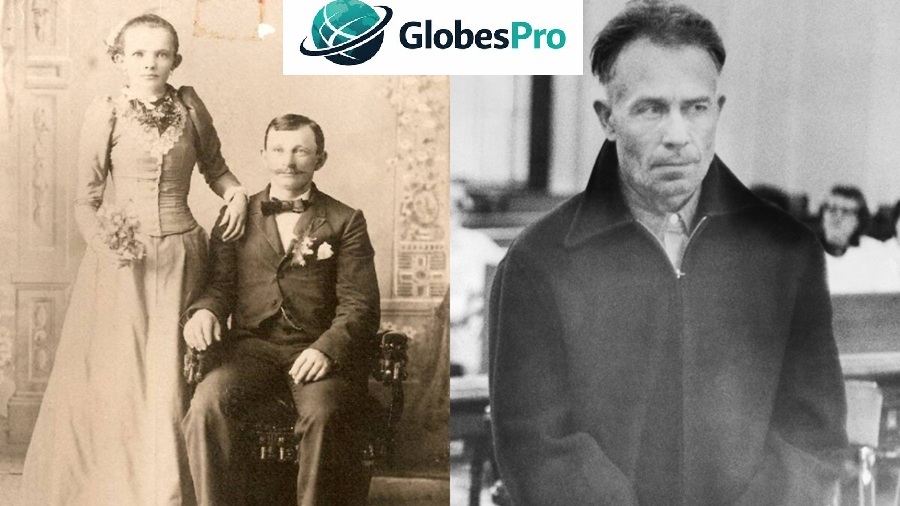
George Philip Gein was the father of Edward Theodore Gein — better known to history as Ed Gein, the Butcher of Plainfield, one of America’s most notorious criminals. Born on August 4, 1873, in Bergen, Wisconsin, George died on April 1, 1940, from heart failure caused by chronic alcoholism. He was 66 years old — and he never lived to see his son’s crimes, his arrest, or the horror that unfolded on that isolated Wisconsin farmstead after his death.
He is not a famous man. He is not a villain in the traditional sense. He is, in many ways, the forgotten figure in a story that has been told thousands of times — a deeply flawed father whose failures helped shape one of the most disturbing cases in American criminal history.
George Philip Gein: Quick Facts
| Detail | Info |
|---|---|
| Full Name | George Philip Gein |
| Born | August 4, 1873 |
| Birthplace | Bergen, Wisconsin, USA |
| Died | April 1, 1940 |
| Death Cause | Heart failure (caused by alcoholism) |
| Burial | Plainfield Cemetery, Plainfield, Wisconsin |
| Wife | Augusta Wilhelmine Lehrke (m. December 11, 1900) |
| Sons | Henry George Gein (1901–1944), Edward Theodore Gein (1906–1984) |
| Occupation | Tanner, carpenter, grocery store worker |
| Portrayed By | Darin Cooper (Monster: The Ed Gein Story, Netflix, 2025) |
Early Life & Background
George was born into a Wisconsin farming family of German descent. His early years were unremarkable by the standards of rural Wisconsin in the 1870s and 1880s — hard work, limited opportunity, and a life defined largely by the land and the seasons.
He grew up in Bergen, a small community in Vernon County, and worked as a tanner and carpenter in his adult years. Neither profession was glamorous, and neither provided the kind of stable, prosperous foundation that would have made the Gein family’s later struggles easier to bear.
On December 11, 1900, George married Augusta Wilhelmine Lehrke in Hamburg, Vernon County, Wisconsin. He was 27. Augusta was 22. What looked like a conventional rural marriage at the turn of the century would turn into something far more complicated.
The Marriage to Augusta: A Household Built on Resentment
The Gein marriage was, by all historical accounts, a deeply unhappy one — and that unhappiness had consequences that rippled forward across generations.
Augusta was a deeply religious woman, a fervent Lutheran who believed with total conviction that the world was inherently sinful, that alcohol was evil, and that women — all women except herself — were instruments of the devil. She was controlling, cold, and psychologically domineering.
George was nearly her opposite. He drank. He struggled to hold down steady employment. He lacked the drive and discipline that Augusta demanded of everyone around her. She despised him for it.
| Aspect | George | Augusta |
|---|---|---|
| Personality | Passive, alcoholic, disengaged | Controlling, religious, domineering |
| Role in Family | Provider (inconsistent) | Absolute moral authority |
| Relationship With Sons | Distant, limited | Possessive, psychologically abusive |
| Stance on Marriage | Largely absent emotionally | Stayed due to religious beliefs against divorce |
Augusta never pursued divorce despite her contempt for George — her religious convictions made that impossible in her mind. So the marriage persisted, cold and resentful, while two boys grew up watching it.
The sons, Henry and Ed, were raised in that atmosphere. George’s alcoholism and passivity meant that Augusta filled the entire emotional and moral space of the household. She became the only authority, the only voice, the overwhelming presence in her sons’ lives.
George as a Father: Absent in the Ways That Mattered
George fathered two sons. Henry George Gein was born in January 1901. Edward Theodore Gein followed in August 1906.
He provided for the family in a basic material sense — working various jobs, helping run the household. But emotionally and psychologically, he was checked out. The alcoholism was a significant part of that. A man who drank excessively was not a man who showed up consistently for his children’s development.
Augusta moved the family to a farm on the outskirts of Plainfield, Wisconsin, partly to isolate herself and her sons from outside influences she considered immoral. That isolation compounded the boys’ limited social world. They had no real community, no friendships outside school that Augusta permitted to develop. They had each other — and they had two parents who modeled dysfunction on a daily basis.
George worked as a grocer at Augusta’s small grocery store for a time, and also continued work as a carpenter and handyman. Community members who knew him during those years described the brothers — Henry and Ed — as reliable and honest workers. George himself doesn’t feature prominently in the community’s collective memory of the Gein family. He was there. He worked. He drank. He faded into the background of a household dominated entirely by his wife.
George’s Death: April 1, 1940
George Philip Gein died on April 1, 1940, in Plainfield, Wisconsin. He was 66 years old. The cause of death was heart failure, directly caused by his decades of heavy drinking.
By the time he died, both his sons were grown men — Henry was 39, Ed was 33. The family had been living on the Plainfield farm for years. Augusta had long since established total control of the household.
His death changed the family dynamic in one specific and important way: it left Ed and Henry to pick up more of the financial slack. The brothers took on additional odd jobs as handymen, and neighbors found them dependable. It was a brief period of apparent normalcy — two adult men supporting a household, working honestly, getting on with their lives.
But George’s death also removed the last buffer, however inadequate, between Augusta and her sons. Whatever presence George had provided — even a passive, alcoholic one — was now gone entirely. Augusta’s grip on Ed in particular tightened further.
What George’s Life Meant for Ed Gein

Trying to trace the roots of what Ed Gein became is not a simple exercise, and it would be wrong to reduce it to any single cause. Criminal psychology doesn’t work that way. But the family environment is impossible to ignore.
George represented, in Augusta’s household theology, everything she preached against. He drank. He failed. He was weak. She held him up as an example — implicitly and explicitly — of what men became without moral discipline. She told her sons he was useless. She made clear she despised him.
And yet George never fought back. He never offered a counter-narrative. He never stood between Augusta and her sons in any meaningful way. His passivity gave Augusta total dominance over the household.
Ed, in particular, absorbed everything Augusta taught. He idolized her. He accepted her worldview completely. George was, in Ed’s emotional landscape, an absence — a man who existed in the house but exerted no real influence.
When George died, Ed barely seemed affected. When Augusta died five years later in 1945, Ed was devastated. He preserved her bedroom exactly as she had left it. He sealed off parts of the house. He descended, over the following decade, into the crimes that would eventually define his name in American history.
George’s shadow over all of this is real — not because he was cruel or monstrous, but because he was absent in the ways that mattered most.
George in Popular Culture: Monster — The Ed Gein Story (2025)
The Netflix series Monster: The Ed Gein Story, which premiered on October 3, 2025, as the third installment in Ryan Murphy and Ian Brennan’s anthology series, brought fresh attention to the entire Gein family — including George.
Actor Darin Cooper portrays George Philip Gein in the series. Notably, his character appears in only one scene — which is itself a telling creative choice. George was a peripheral figure in the real story, and the series reflects that accurately.
Charlie Hunnam stars as Ed Gein, with Laurie Metcalf playing Augusta. The series focuses heavily on Ed’s relationship with his mother — the central psychological thread that most historians and criminologists consider the dominant influence in his development.
The renewed interest in the series brought many viewers to search for George Philip Gein specifically, wanting to understand who this man was, what he actually did, and how much responsibility — if any — he bears for what his son became.
| Production Detail | Info |
|---|---|
| Series | Monster: The Ed Gein Story |
| Network | Netflix |
| Premiere Date | October 3, 2025 |
| Actor Portraying George | Darin Cooper |
| Actor Portraying Ed | Charlie Hunnam |
| Actor Portraying Augusta | Laurie Metcalf |
| George’s Screen Time | One scene |
George Philip Gein vs. Augusta Gein: The Contrast
It’s impossible to discuss George without comparing him to Augusta, because the contrast between them is what defined the Gein household.
Augusta has received extensive psychological analysis over the decades. She is widely considered one of the primary figures in understanding Ed’s psychology — her religious extremism, her possessiveness, her contempt for all women outside herself, and her emotional manipulation of Ed are well-documented.
George gets far less attention. He was, in a sense, the anti-Augusta — passive where she was active, weak where she was forceful, disengaged where she was consuming. In a healthier family structure, a father’s stable, grounded presence can provide a counterweight to an overbearing mother. George provided no such counterweight.
That failure is not the same as malevolence. George Gein was not a cruel man. He was not violent. He was not a monster. He was an alcoholic who couldn’t keep steady work, married a woman who made no secret of her contempt for him, and raised two sons in a household where he had effectively surrendered all authority.
The result, in the case of his younger son, was catastrophic.
Henry Gein: The Brother Who Saw Clearly

George and Augusta’s older son Henry deserves mention here because his story is directly connected to his father’s legacy and his own complicated death.
Henry was born on January 17, 1901, making him five years older than Ed. He worked alongside Ed as a handyman after their father’s death and, unlike Ed, showed signs of breaking free from Augusta’s influence. He began dating a divorced woman with two children — something Augusta would have found deeply objectionable. He spoke critically of his mother around Ed, openly questioning her behavior.
On May 16, 1944, Henry and Ed were burning marsh vegetation on the farm property. The fire got out of control. When the firefighters left at the end of the day, Ed reported Henry missing. A search party found Henry’s body face down in an area that had not been touched by the fire.
Henry had bruises on his head. No autopsy was performed. The official cause of death was listed as asphyxiation. No investigation was conducted.
Many criminologists and historians have since concluded it is likely — possible at minimum — that Ed killed his brother. Henry had been pulling away from Augusta. Ed could not tolerate that. With Henry gone, Ed and Augusta were alone together for the final year of her life.
George Gein never knew any of this. He was already four years dead.
Burial & Legacy
George Philip Gein is buried at Plainfield Cemetery in Plainfield, Wisconsin — the same cemetery where Augusta and Ed are also interred. The Gein family plot sits in a small, quiet corner of a small, quiet Wisconsin town that became famous for all the wrong reasons.
Ed’s gravestone was repeatedly vandalized by souvenir seekers over the years, with pieces chipped away until the stone itself was stolen in 2000. It was recovered near Seattle in 2001 and placed in storage. Ed’s grave has remained unmarked since.
George and Augusta’s graves have received far less attention. They are not the names people come looking for.
FAQs
Who was George Philip Gein? He was the father of serial killer Ed Gein, born in Bergen, Wisconsin on August 4, 1873. He worked as a tanner, carpenter, and grocer, and died of heart failure caused by alcoholism on April 1, 1940.
What did George Philip Gein do for a living? He worked as a tanner, carpenter, and helped operate Augusta’s small grocery store. He also took on handyman work throughout his adult life.
How did George Philip Gein die? He died on April 1, 1940, at the age of 66, from heart failure caused by his chronic alcoholism.
Was George Philip Gein abusive? There is no historical record of George being physically violent or abusive. He was largely passive and disengaged — an alcoholic who effectively surrendered authority in the household to Augusta entirely.
Who plays George Philip Gein in the Netflix series? Actor Darin Cooper portrays George Philip Gein in Monster: The Ed Gein Story (Netflix, 2025), though the character appears in only one scene.
Where is George Philip Gein buried? He is buried at Plainfield Cemetery in Plainfield, Waushara County, Wisconsin.
Did George Gein know about Ed’s crimes? No. George died in 1940 — seventeen years before Ed’s arrest in 1957. He had no knowledge of what his son would eventually become.
Conclusion
George Philip Gein was not a remarkable man. He was an alcoholic carpenter from rural Wisconsin who married a woman who despised him, fathered two sons he couldn’t adequately parent, and died quietly at 66 from the consequences of his own choices.
He was not evil. He was not monstrous. He was inadequate in ways that had consequences far beyond anything he could have imagined — or lived to see.
History remembers the Gein name for Ed’s crimes. Augusta gets analyzed extensively for her psychological impact. George gets one scene in a Netflix series and a footnote in most books.
But understanding who George was — his passivity, his alcoholism, his complete surrender of parental presence — is part of understanding how a household becomes the kind of place that shapes a broken person. He didn’t create Ed Gein. Nothing is ever that simple. But he also never stood in the way of what Augusta was building, and that absence has its own weight.
He is buried in Plainfield. The town has never fully shaken the name his son made famous. And George Philip Gein, the man who started it all by simply not being present enough, rests quietly beside the family he never really held together.
