
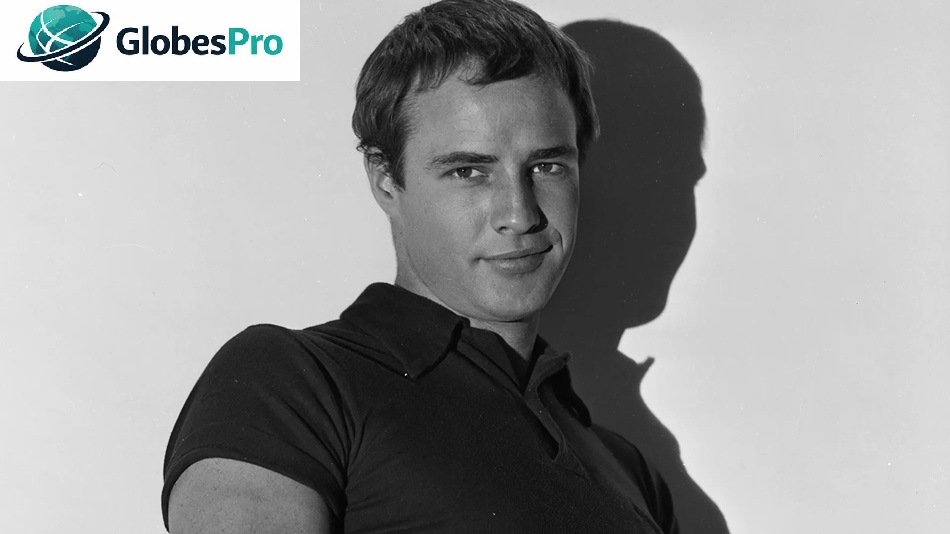
Marlon Brando did not merely change American acting — he made everything that came before him look like a different art form entirely. When he walked onto a Broadway stage as Stanley Kowalski in 1947, something shifted permanently in what audiences expected from a performer. The raw psychological truth he brought to that role, and to the screen performances that followed, created the template against which every American actor since has been measured.
The paradox at the center of his life is this: the man who revolutionized his profession held it in open contempt, describing acting as a neurotic impulse and a bum’s life. He produced some of the most indelible performances in cinema history while spending large portions of his career in deliberate self-sabotage, exile, and excess. He was, simultaneously, the best and the most wasteful actor of his generation — and both things are completely true.
Wiki Info Table
| Field | Details |
|---|---|
| Full Name | Marlon Brando Jr. |
| Born | April 3, 1924 — Omaha, Nebraska |
| Died | July 1, 2004 — UCLA Medical Center, Los Angeles (aged 80) |
| Cause of Death | Pulmonary fibrosis; congestive heart failure |
| Nationality | American |
| Heritage | Dutch, Irish, English, German |
| Father | Marlon Brando Sr. — traveling salesman |
| Mother | Dorothy “Dodie” Pennebaker Brando — amateur actress; alcoholic |
| Sisters | Jocelyn Brando (actress); Frances Brando |
| First Wife | Anna Kashfi (m. 1957 — div. 1959) |
| Second Wife | Movita Castaneda (m. 1960 — div. 1962) |
| Third Partner | Tarita Teriipaia — co-star, Mutiny on the Bounty; long-term partner |
| Children | At least 11 recognized children including Christian Brando, Cheyenne Brando, Miko Brando, Simon Teihotu Brando, Rebecca Brando, Ninna Priscilla Brando, Myles Jonathan Brando, Timothy Gahan Brando |
| Education | Shattuck Military Academy (expelled); New School for Social Research — studied under Stella Adler |
| Occupation | Actor; Director; Activist |
| Known For | A Streetcar Named Desire; The Godfather; On the Waterfront; Apocalypse Now |
| Academy Awards | Best Actor — On the Waterfront (1954); Best Actor — The Godfather (1972, declined) |
| Other Awards | Two Golden Globes; three BAFTAs; Cannes Film Festival Award; Emmy Award |
| Oscar Nominations | Eight total — a record at the time |
| Notable Activism | Civil rights movement; Native American rights; declined 1972 Oscar in protest |
| Tetiaroa | Purchased private Polynesian atoll — 1966; his primary retreat from Hollywood |
| Autobiography | Songs My Mother Taught Me (1994) |
| Net Worth at Death | Estimated $26 million — significantly diminished by legal fees, alimony, and lifestyle |
Early Life: Omaha, Illinois, and a Difficult Childhood
Marlon Brando Jr. was born April 3, 1924, in Omaha, Nebraska, the only son and youngest of three children in a household that projected middle-class stability while concealing significant dysfunction. His father, Marlon Sr., was a traveling salesman — stern, emotionally withholding, and contemptuous of his son’s sensitivity and artistic inclinations. His mother Dorothy, known as Dodie, was an amateur actress with genuine theatrical connections — she was instrumental in encouraging Henry Fonda toward a professional acting career in Omaha’s community theater scene — but was also a serious alcoholic whose unreliability as a parent left lasting damage.
The family moved to Evanston, Illinois when Brando was six, and later to Libertyville, Illinois after his parents separated and reconciled. Growing up between a cold, dismissive father and an alcoholic mother who was the great love of his childhood, Brando developed the combination of emotional hunger and defensive self-sufficiency that would define both his acting and his personal life.
He was expelled from Shattuck Military Academy in Minnesota after years of rebellion and academic failure. His father, exhausted and at a loss, gave him a job digging ditches. When his sister Frances invited him to New York to pursue acting, he left the ditch without looking back. He was eighteen years old.
New York and Stella Adler: The Education That Mattered
Brando arrived in New York in 1943 with no formal training and an instinctive talent that immediately attracted serious attention. He began studying at the New School for Social Research under Stella Adler — a teacher whose influence on American acting is difficult to overstate. Adler had studied directly with Konstantin Stanislavski and brought his system to American theater with a rigor and intelligence that distinguished her approach from the more psychologically intense Method teaching of Lee Strasberg at the Actors Studio.
What Adler gave Brando was a framework for what he already did naturally: finding the psychological truth of a character from the inside out, using imagination and emotional memory to produce behavior that was genuinely felt rather than technically demonstrated. She also opened him, by her own account, to great literature, music, and theater beyond the American commercial tradition. He credited her throughout his life as the most important teacher he ever had.
He made his Broadway debut in I Remember Mama in 1944, earned Theater World Awards for his performances in Candida and Truckline Cafe in 1946, and was voted Broadway’s Most Promising Actor by New York theater critics the same year. The stage work established his reputation in the industry before the role arrived that would establish it with the world.
A Streetcar Named Desire: The Role That Changed Everything
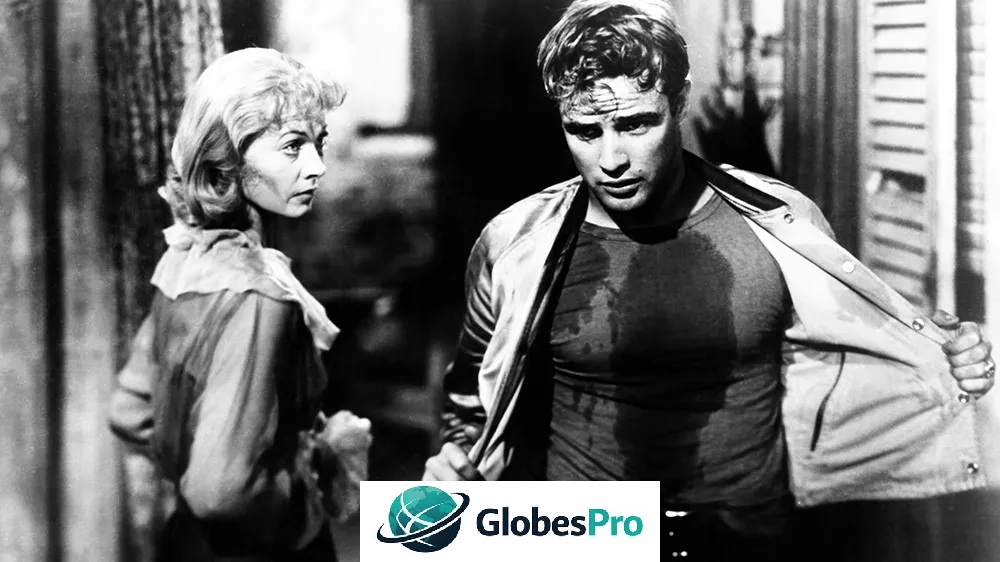
In 1947, director Elia Kazan cast Brando as Stanley Kowalski in Tennessee Williams’s A Streetcar Named Desire on Broadway, opposite Jessica Tandy as Blanche DuBois. The performance was a cultural event. Brando’s Stanley was not the theatrical villain the material might have suggested — he was raw, sexual, violent, and utterly real in a way that American stage acting had not publicly produced before. Audiences and critics responded with something close to shock.
The 1951 film adaptation, also directed by Kazan, fixed the performance permanently in American cultural memory. Brando was nominated for the Academy Award for Best Actor. He lost to Humphrey Bogart for The African Queen — a decision history has not been particularly kind to. The film established him as the most talked-about actor in Hollywood before he had made five pictures.
What made the Kowalski performance revolutionary was not the mumbling or the T-shirt — those were surface details that critics and imitators fixated on. What was revolutionary was the quality of attention Brando brought to every moment, the sense that the character existed independently of the script, that something real was happening rather than something performed. No American film actor had produced that quality so completely and consistently before.
The Golden Decade: 1951–1960
The years following Streetcar established Brando as the most versatile and most scrutinized actor in Hollywood. He was nominated for the Academy Award for Best Actor four consecutive years — for Viva Zapata! (1952), Julius Caesar (1953), On the Waterfront (1954), and Sayonara (1957) — winning once, for On the Waterfront.
On the Waterfront, directed again by Kazan, gave him his most complete dramatic performance of the decade. As Terry Malloy, the washed-up boxer who decides to testify against his mob-controlled union, Brando produced a performance of such concentrated emotional truth that it remains the reference point for naturalistic screen acting. The “I coulda been a contender” scene with Rod Steiger — improvised in significant part, shot in a taxi — is one of the most studied pieces of film acting ever recorded.
Julius Caesar (1953) demonstrated a range his detractors had questioned — the mumbling method actor from the American streets delivering Shakespeare’s Mark Antony with sufficient classical authority that John Gielgud, one of the great Shakespearean actors of the century, offered him a full season at the Hammersmith Theatre. Brando declined, as he declined most things that would have confirmed he took the craft seriously.
He also demonstrated commercial flexibility during this period — Napoleon in Désirée (1954), Sky Masterson in Guys and Dolls (1955), a singing and dancing role that nobody expected him to attempt, and a Nazi officer in The Young Lions (1958). From 1955 to 1958, theater exhibitors voted him one of the top ten box office draws in America. He was, briefly, the biggest star in Hollywood — a position he seemed to find actively uncomfortable.
The Long Decline: 1960–1971
What followed the golden decade is one of Hollywood history’s most documented cases of talent in deliberate retreat. The causes were multiple and interconnected: growing disillusionment with the film industry, the death of his mother in 1954 which by all accounts permanently diminished his drive, complicated personal relationships, and a growing conviction that acting was beneath a serious person’s sustained investment.
One-Eyed Jacks (1961), the only film he ever directed, consuming enormous time and money, was a financial disappointment. Mutiny on the Bounty (1962) became a scandal — Brando was accused of deliberately sabotaging production, running up costs through behavioral excess, and treating the enterprise with contempt. The Saturday Evening Post ran a headline calling it “Six Million Dollars Down the Drain.” Studios began to fear him as much as they wanted him.
He made films throughout the 1960s — The Chase, Reflections in a Golden Eye, Candy — none of which approached his earlier work. Critics noted his fluctuating weight, his apparent disengagement, and the waste of a talent that had seemed limitless a decade earlier. He retreated increasingly to Tetiaroa, the Polynesian atoll he purchased in 1966, treating Hollywood as a place to extract money from rather than a community to belong to.
The Godfather: The Second Coming
Francis Ford Coppola’s The Godfather in 1972 is one of cinema’s great second acts — for the film and for its central performer. The studio did not want Brando. He had spent a decade proving himself unbankable, difficult, and physically transformed from the lean intensity of his early career. Coppola fought for him. Brando screen-tested with cotton stuffed in his cheeks and shoe polish in his hair, and Paramount relented.
Don Vito Corleone is among the most fully realized characters in American film history — a patriarch of genuine warmth and absolute authority, whose power rests not on violence but on the gravity of his presence and the weight of his obligations. Brando played him at sixty-seven years old in the story’s timeline — a man whose body had aged while his mind retained complete clarity — with a physical specificity and vocal invention that transformed a gangster into a figure of genuine tragic dimension.
The performance won him the Academy Award for Best Actor. He declined it — sending Sacheen Littlefeather to the ceremony to read a statement protesting Hollywood’s treatment of Native Americans. The protest was genuine; Brando’s activism on behalf of Native American rights and the civil rights movement was a consistent thread through his adult life, not a publicity exercise. The image of Littlefeather on the Oscar stage remains one of the most discussed moments in Academy Awards history.
Last Tango in Paris (1973), Bernardo Bertolucci’s sexually explicit psychological drama, demonstrated that the Godfather performance was not a nostalgic peak but an active creative resurgence. He received his eighth Oscar nomination. The film’s controversy — particularly regarding a scene whose production ethics have been extensively debated — complicated its legacy without diminishing the performance’s raw power.
The Later Years: Superman, Apocalypse Now, and Selective Engagement
After Last Tango, Brando largely withdrew from sustained film work and extracted extraordinary fees for minimal appearances. He earned nearly four million dollars for approximately twelve minutes of screen time in Superman (1978) — making him the highest-paid actor per minute of screen time in history at that point. Apocalypse Now (1979), Coppola again, gave him Colonel Kurtz — a role of perhaps fifteen minutes that carries the entire film’s philosophical weight. He arrived on set overweight and underprepared, improvised extensively, and delivered something genuinely haunting.
The pattern continued through the 1980s and 1990s — A Dry White Season (1989) earned him an Oscar nomination for Best Supporting Actor, his first supporting nomination after seven lead nominations. The Freshman (1990) showed a self-awareness and comic lightness that surprised audiences. Don Juan DeMarco (1994) demonstrated he could still command a screen. The Island of Dr. Moreau (1996) was a disaster by all accounts.
His final film appearance was in The Score (2001), alongside Robert De Niro and Edward Norton — a passing of the torch that he seemed to approach with characteristic ambivalence.
Family: The Complicated Legacy
Brando’s personal life generated as many headlines as his professional one — and far more tragedy. He was married three times: to actress Anna Kashfi in 1957, Mexican actress Movita Castaneda in 1960, and his Mutiny on the Bounty co-star Tarita Teriipaia, with whom he had a long partnership centered on Tetiaroa. He recognized at least eleven children in his will, born to multiple women across decades.
The family tragedies were severe. His son Christian, born to Anna Kashfi in 1958, shot and killed Dag Drollet — the boyfriend of his half-sister Cheyenne — at Brando’s Los Angeles home in 1990, claiming the shooting was accidental during a confrontation over Drollet’s alleged abuse of Cheyenne. Christian was convicted of voluntary manslaughter and served five years. The trial consumed Brando financially and emotionally.
Cheyenne, born to Tarita Teriipaia in 1970, had been severely injured in a car accident in Tahiti in 1989 that left her with lasting psychological and cognitive effects. The Drollet killing deepened her trauma. She attempted suicide multiple times. On April 16, 1995, she died by suicide at her mother’s home in Tahiti. She was twenty-five years old.
Christian Brando died of pneumonia in January 2008, four years after his father. He was forty-nine.
Timothy Gahan Brando — born January 6, 1994, to Brando and Maria Cristina Ruiz, his youngest child — has lived entirely privately, avoiding the public life that consumed and damaged so many members of his family.
Activism and Legacy Beyond Film
Brando’s activism was not peripheral to his identity — it was central to it. His involvement in the civil rights movement included marching with Martin Luther King Jr. He was a vocal and financially generous supporter of Native American rights for decades before the 1973 Oscar protest made it his most famous public act. He traveled to the South during the Freedom Rides. He put money and presence behind causes at personal professional cost.
His autobiography, Songs My Mother Taught Me, published in 1994, revealed a man who had spent his entire career resisting the reduction of his identity to his performances — who wanted to be understood as a person with political and philosophical commitments, not merely as a vessel for other people’s characters. The book is notably more engaged when discussing his mother, his activism, and Tetiaroa than when discussing his films. That tells its own story.
Death and Enduring Influence
Marlon Brando died on July 1, 2004, at UCLA Medical Center, of pulmonary fibrosis complicated by congestive heart failure, diabetes, and liver cancer. He was eighty years old. The tributes were universal and, for once, warranted — the consensus that he was the most influential American actor of the twentieth century had been settled long before his death.
His influence runs through every serious American screen actor who followed him. Al Pacino, Robert De Niro, Dustin Hoffman, Jack Nicholson — the generation that dominated American film in the 1970s grew up with Brando as the standard. James Dean, who died at twenty-four, was already working to define himself in relation to Brando’s example. The chain extends unbroken to the present.
Conclusion
Marlon Brando spent eighty years on earth, fifty of them performing, and managed to permanently transform an art form while simultaneously treating it with contempt. The performances survive — Kowalski, Terry Malloy, Don Corleone, Kurtz — each one a different argument for what screen acting can be at its highest. The waste survives too, honestly accounted for. Both belong to the full picture of who he was.
FAQs
What is Marlon Brando best known for? His performances as Stanley Kowalski in A Streetcar Named Desire, Terry Malloy in On the Waterfront, Don Vito Corleone in The Godfather, and Colonel Kurtz in Apocalypse Now — four of the most studied roles in American film history.
How many Academy Awards did Brando win? Two — Best Actor for On the Waterfront (1954) and Best Actor for The Godfather (1972). He accepted the first and famously declined the second in protest of Hollywood’s treatment of Native Americans.
Why did he decline the Oscar for The Godfather? He sent Native American activist Sacheen Littlefeather to the ceremony to read a statement protesting Hollywood’s historical stereotyping and mistreatment of Native Americans — a cause he had supported for decades.
What tragedies affected his family? His son Christian was convicted of voluntary manslaughter in 1990 for killing his half-sister Cheyenne’s boyfriend. Cheyenne died by suicide in 1995 at twenty-five. Christian died of pneumonia in 2008.
Who was Stella Adler and why did she matter to Brando? A legendary acting teacher who had studied directly with Stanislavski and brought his system to America. Brando credited her as the most important teacher of his life — she gave intellectual and emotional framework to a talent that had previously operated entirely on instinct.
Where did Brando retire? Tetiaroa, a private Polynesian atoll he purchased in 1966, became his primary retreat from Hollywood. He spent increasing amounts of time there from the late 1960s onward and considered it his true home.
